
Expect unsettled waters in Maine’s Democratic Senate primary to challenge Collins
Primary poll shifts are normal as voters consider Graham Platner, Janet Mills and others.

Next week Mainers will finish casting their ballots on Question 1, a voter suppression measure.. A “no” vote protects access to absentee ballots.
Proponents have used misleading tactics from the time they asked voters to sign petitions to put the measure on the ballot and continue doing so. The race looks tight but there are still many opportunities for people to get involved in the campaign and to vote.
Seven months from now Maine Democrats will pick who they’ll run against Republican Sen. Susan Collins. Right now the main contenders are Graham Platner and Janet Mills, but it’s also possible other declared candidates will rise in support and more will jump into the race.
Platner’s gained a lot of attention, not all of it good.
After a slew of national reporters and pundits pointed to his populist appeal and potential with an electorate poised to reject older, more establishment candidates, stories emerged about Platner’s troubling Reddit posts and Nazi tattoo. His political director and campaign manager resigned, the former because she wasn’t informed about issues with Platner’s background and the latter because of family developments.
Press coverage and analysis isn’t as positive toward Platner anymore. Rather, it gotten more mixed and even sometimes negative.
Still, Platner continues to attract considerable crowds. His strongest backers say he’s an example of how people can change and grow and they’re sticking with him.
By contrast, Mills is mostly going about doing her job.
The other day Mills opened an affordable housing development that’s the newest in a $315 million, multi-year building program. Not long before, Mills spoke to lawyers about the need to defend the rule of law, and called out Trump, saying “The president’s demand, the impermissible threat in his words, the attempt to govern by intimidation -- this is not what the founders meant when they wrote the Constitution; it is, in fact, the very thing they most feared when they divided power among three co-equal branches of government.”
With debates, events, fundraising, ads, organizing and more, campaigning will shift in the months to come.
And it’s quite likely that polls will change, too.
Primary polls are especially volatile.
Polls are never perfect barometers and we can only be certain that they only (kind of) measure a moment. That’s why (to mix metaphors), they’re often called snapshots in time.
And it’s in primaries where shifts happen the most. Sometimes those are dramatic.
Consider the 2012 Republican Presidential primary.
Mitt Romney (in purple in the graph below) started ahead and ultimately prevailed, but at times four different candidates had the lead.
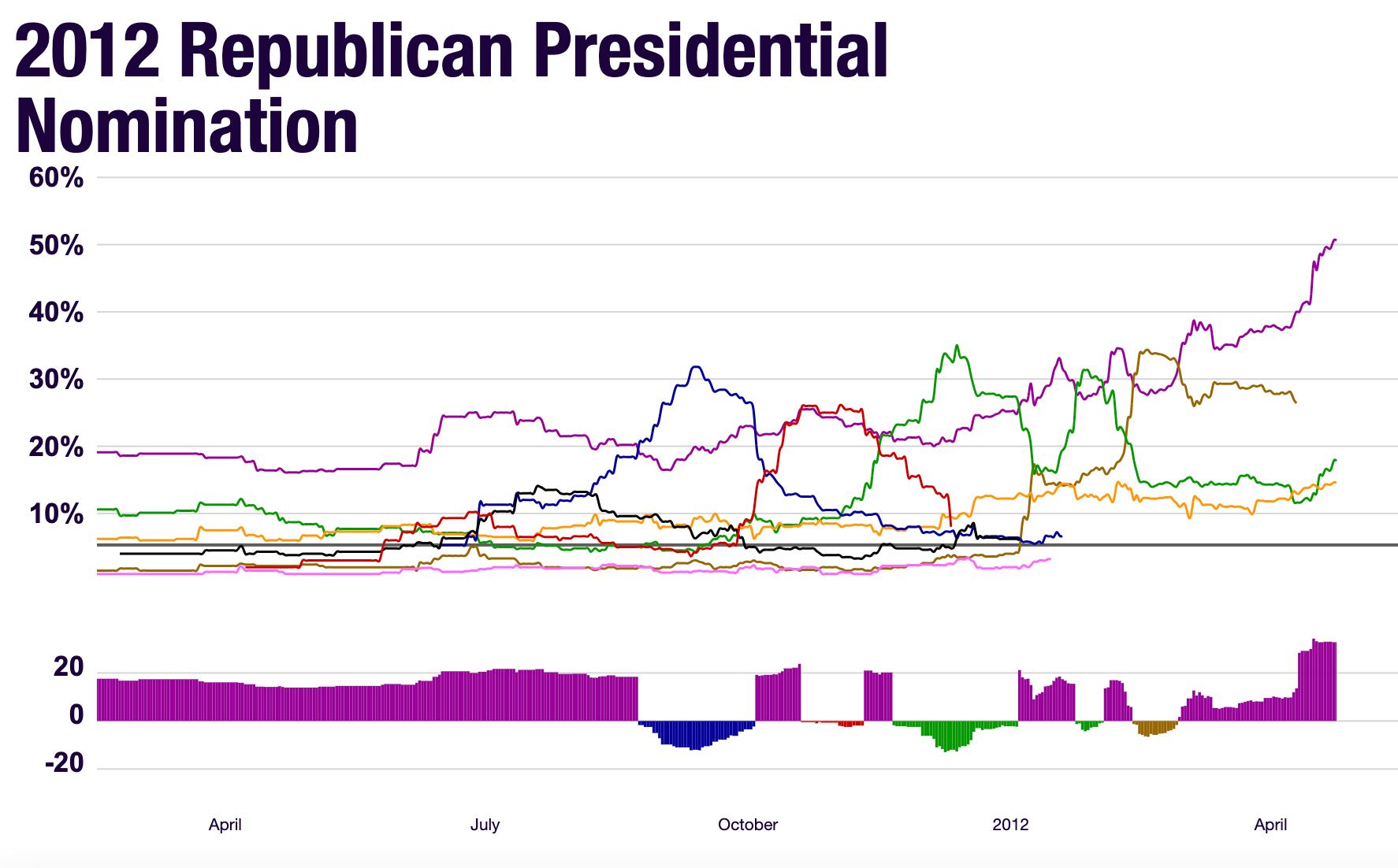
Image: RealClearPolitics poll averages
Rick Perry (shown in navy in the graph) was more than 10 percentage points ahead of Romney in September 2011 before declining.
But his candidacy fell off even more after a debate in which Perry started out saying he’d eliminate three federal agencies and then forgot which ones those were. By the end of that part of his response, Perry was reduced to sputtering “Sorry. Oops.”
Voters saw Perry’s awful debate performance and media coverage was brutal.1
Newt Gingrich, Rick Santorum and Herman Cain (does anyone remember that guy?) also lead Romney at various points.
And it’s not just in presidential races where polling changes happen. Frequently Senate candidates are not that well-known and that matters.
Why are primary polls so variable? There’s three main reasons.
Voters are still learning about candidates, so they’re updating their assessments and choices. In primaries, what voters learn matters more than initial impressions. Lesser-known candidates are especially sensitive to new information and revelations, which can shift support rapidly.
Primaries often don’t have huge turnout (but they can). Primary voters are a fraction of the general electorate, making each vote proportionally more impactful. A small shift in turnout or enthusiasm can produce large swings.
Voters often decide late. Some political science studies found that up to 40% of primary voters make their decision in the last few weeks, compared to roughly 10–15% in general elections.
Even when polling is professional and top rate, voter learning and emerging controversies can make primary polls volatile.
And, as always, who turns out matters (and that makes a campaign’s capacity to organize voters important).
In watching polling, the trend is your friend.
Volatility isn’t usually a flaw in polling.
Yes, sometimes when polls swing a lot, it’s because some pollsters did a bad job in how they drew or weighed their samples. Or maybe they wrote really bad, biased survey questions.
But typically change in poll results is a reflection of what voters are doing. They’re gathering information as campaigns go on.
For a candidate still building recognition like Platner, controversies can shift support a fair amount.
In primaries, the trajectory of support matters more than a single snapshot. Following trends shows whether support is stabilizing or fading.
People keep taking in new information from their friends, social media, the campaigns and candidates, and the mass media. News cycles, debates, and endorsements incrementally change what people know. As this happens, voters keep updating their knowledge and perceptions. They’re learning and reassessing.
Platner’s entry brought him attention and campaign cash, but also new scrutiny. Mills is starting to reintroduce herself as she pivots from governance to campaigning. Some voters are looking at other candidates already in the race. It’s possible others Maine figures, seeing the unsettled situation, may yet jump in.
A poll released last week by UNH had Platner strikingly ahead of Mills but this was before many of the revelations and as earlier reports were just sinking in.
Another poll from a fairly unknown pollster, taken later, had Mills ahead of Platner before any information was provided about the candidates and with a much larger lead after the Nazi tattoo was mentioned to respondents.2
Given the rapidity of the news and the big difference in these pollsters’ reputations, it’s hard to know if that change was real.
But whatever happened or didn’t happen with Mainers’ views in the last few weeks, we should all expect that, like in other primaries, Maine Democrats are still forming opinions.
Primaries are good precisely because voters get new information and keep learning.
Keep all this in mind as you watch the race. Don’t fixate on a single poll and maybe ignore all of them. It’s more important for voters to do due diligence in evaluating candidates.
And if you’re a Maine voter, make sure you cast your ballot by November 4. Absentee ballot requests are high for a referendum election. A “no” vote on Question 1 will preserve and protect Maine’s absentee ballot system.
Perry’s debate blip and his views about abolishing agencies, including the Department of Energy, came back to haunt him after Trump nominated him in 2017 to head, you guessed it, the Department of Energy. This came up in Perry’s Senate confirmation hearing. As CNN reported, “While the comment became an albatross for Perry’s doomed presidential campaign, the governor also used the flub to deflect from tricky questions on Thursday. When Sen. Mazie Hirono of Hawaii asked Perry about reported cuts proposed by the incoming Trump administration, Perry quipped, ‘Well, senator, maybe they will have the same experience I had and forget that they said that.’”
There was also a garbage poll from national Republicans purporting to show that voters were more likely to support Platner after hearing about his Nazi tattoo. One major flaw in the survey was how the question was phrased. Not only did it describe the tattoo as “anti-Israel,” but it buried that lie/mischaracterization amidst other descriptions of Platner’s statements and responses.
Jordan Wood should be a lot more viable now that Platner’s shine seems to have faded a bit. One would think we would have learned by now that when they tell you who they are, you had better believe them. Never forget, trump was a populist candidate back in 2015 too. You cannot be all things to all people in a functioning Democracy like ours is supposed to be. This country ran on making compromises for decades; some good, some not so good but the work got done for the overall betterment of the country. Look at where populism has gotten us today. We have got to get smarter about those we elect to office or we’re sunk.
Interesting that you didn’t mention Jordan Wood. I know he’s polled quite low (around 8%, I think), but it looks like he’ll be a factor in the race, especially if there are three candidates and ranked choice voting applies. It’s such a strange time, though, isn’t it? Anything but normal, so I expect many swings in the coming months.