
How Troy Jackson or someone else could replace Platner
There's a pull the emergency cord scenario

Reports about Platner’s sexting emerged last weekend. Now the NY Times (gift link) has a news story about him being abusive to women, including a 2021 incident in Maine when a girlfriend found his unwanted, drunken presence to be “reckless” and “unsettling.”
Moreover, the paper has texts from August showing that Platner knew his tattoo was a Nazi symbol months before news about it became public. And more.
Given how late this is in the primary race, the lack of excitement for other candidates, and the tendency for many Platner supporters to excuse all and attack those talking about these incidents, I still think it’s very likely Platner will win the Senate nomination.
However, there could be pressure after that for Platner to remove himself from the general election matchup, especially if these women start giving interviews and even more negative stuff comes out.
If Graham Platner withdrew after becoming the nominee, then what?
Maine Democrats would have to act quickly.
State law allows for filling a vacancy on the general election ballot if the candidate withdraws on or before the second Monday in July, which is July 13 this year.
Then the political party can add the replacement on or before the fourth Monday in July, which is July 27 this year.
Thus there would only be two weeks to put a different Democratic candidate on the ballot to face Sen. Susan Collins.
Who could replace Platner?
I think that the best options are the three Democratic gubernatorial candidates who endorsed each other, all of whom Platner ranked. Those are Troy Jackson, Platner’s top rank, Shenna Bellows and Hannah Pingree.
Of course if one of them wins the nomination for governor, he or she won’t run for Senate. Given that the race uses ranked choice voting, it will take some time to determine the winner.
If none of those three advance in the governor’s race, Troy Jackson matches the populism of Platner quite well.

Jackson’s made his career standing up for the working class and labor rights, working to expand health care and focusing on addressing the growing concentration of wealth.
Moreover, as Andy O’Brien notes:
Even as Troy’s district became more conservative in the 2010s, he still managed to appeal to voters across political parties and win his re-election campaigns. Even as Trump won Troy’s district three times by substantial margins, Troy continued to be elected until he was termed out of the State Senate in 2024.
Shenna Bellows and Hannah Pingree are also terrific candidates. I’ve written about them myself, as has O’Brien in the article I’ve referenced.
Perhaps there are other strong possibilities, but these three stand out because they have been running very active, engaged statewide campaigns.
One potential stumbling block is that candidates for state office cannot transfer funds funds to federal campaigns. They can give back the money to donors and then, using only newly raised contributions, ask people to donate again.
However, I don’t think this is a huge deal now, in that, if Platner withdrew — again, that would have to be his move — he’d probably do that after communicating about next steps, one of which might be transferring his campaign war chest to another Democrat.
Yes, this is wholly hypothetical and perhaps nothing like this will happen.
If it did, one would hope it could unfold with as little drama and upset as possible.
Meanwhile, we’re seeing that, despite the very real strengths of the Platner campaign, there’s been an glaring problem lurking underneath.
Recruiters never adequately vetted Graham Platner, leaving him and Democrats exposed.
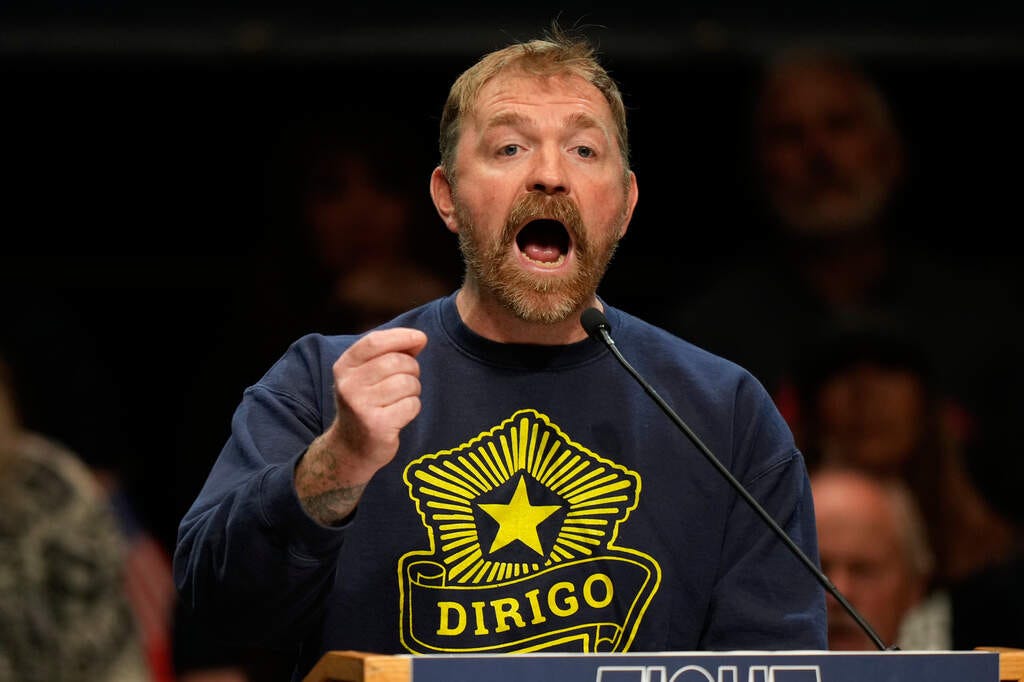
Graham Platner, Democratic candidate for U.S. Senate, speaks at an event in Orono, Maine, Sunday, May 24, 2026. (Robert F. Bukaty/AP)
What happens in a normal high profile campaign is that a candidate’s own campaign does opposition research on them. This enables them to plan how to respond to likely attacks.
But that clearly wasn’t done in Platner’s case, at least not in depth. As a great piece in Politico by Michael Kruse recounts, Platner was recruited by the “marginally Boston-based but mainly itinerant duo Daniel Moraff and Leanne Fan,” who had gotten some other candidates to run elsewhere.
Platner was not their first choice to “take the blue-collar lane.”
Chris Williams, the former president of the Machinists Local S6 in Bath, was going to be Platner before Platner. “It was a go,” Williams told [journalist Kruse]. “But there was a skeleton in the closet that wasn’t true that we would’ve had to explain,” he said. “They decided to go in a different direction” — some two and a half hours northeast.
Moraff and Fan’s initial destination downeast was Platner’s mother’s restaurant, Ironbound in Hancock. She gave them Graham’s phone number, a call was made and a meeting arranged. Then Moraff called Morris Katz, a “New York-based strategist” about this potential candidate.
This initial contact and discussions between the recruiters and Platner happened in July 2025. Platner’s announcement video was released August 19 and went viral.
Because a full vet wasn’t done, the campaign learned about issues after it launched.
The campaign was blindsided by Platner’s old Reddit posts and his tattoo, which became big news stories in October.
And, dear reader, it should never have been up to Platner’s wife, Amy Gertner, to approach a campaign staffer to flag the existence of those messages. And this should not have happened weeks after the campaign started.
The out-of-state operatives did a profound disservice to both Graham Platner and Amy Gertner. Platner and Gertner were political neophytes. But Platner’s handlers possessed high-level campaign experience and knew better.
It looks like that, because the recruiters’ first choice failed vetting (ironically “for something that wasn’t true”) and because they had an arbitrary start date for the campaign and needed to film the launch video and set up press and events beforehand, they did a cursory job vetting Platner.
That left the campaign unprepared when embarrassing news emerged, but it also sparked another issue — trust.
The vast majority of Maine Democrats never heard of Graham Platner a year ago and most hitched hopes to him of finally defeating Susan Collins. Platner and many others also see this race more broadly, as about the direction of the Democratic party and enacting progressive policies.
Poor vetting by the folks who recruited Platner endangers all that. The campaign botched basic due diligence, and then resorted to heavy-handed, thuggish tactics to threaten a former staff member.
The campaign also let Graham Platner go out and say the press wasn’t honest about the vetting story and committed “journalistic malpractice” although his wife didn’t deny what was reported.
That undermines Graham’s credibility in a way that his response to the Reddit posts didn’t.
Now, to be sure, the Platner campaign has been phenomenal in some ways. Graham Platner’s own strengths have played very well to the angst and pressures of our times.
But his candidacy also has weaknesses that weren’t apparent in the exciting, heady days of the fall.
Uncertainly looms, so you just keep doing you.
If you haven’t voted already, make sure you do so by Election Day, Tuesday June 9.
And if you are interested in the pull the emergency cord scenario, tell the Platner campaign, the gubernatorial candidates and others.
Abusive? Nope. A jerk? Sure. Disqualifying? No. Stop it.
The political “professionals” on the Platner campaign owe Amy and Graham a huge apology and they should be embarrassed by the services they’ve provided. Great piece Amy.